Microplastic Water Monitoring: Why Smaller Particles Matter Now
Most people imagine microplastic pollution as tiny fragments that can be caught, counted and compared with a microscope. The more difficult reality is that the smallest particles are often the most important and the easiest to miss. A new open-access study in npj Clean Water, published on 17 August 2026, puts that measurement gap back in the spotlight. The research team tested a machine learning-assisted spectral flow cytometry method on Lake Geneva, nearby rivers and depth samples, then reported that a very large share of detected particles sat in the 1-20 µm range.
That finding does not mean every lake has the same profile, and it does not prove a direct health outcome for readers. It does show why water monitoring, product rules and everyday prevention advice need to be more precise. If a monitoring programme only captures larger particles, it can make a water body look cleaner than it is, or make two locations appear comparable when the methods are not comparable.
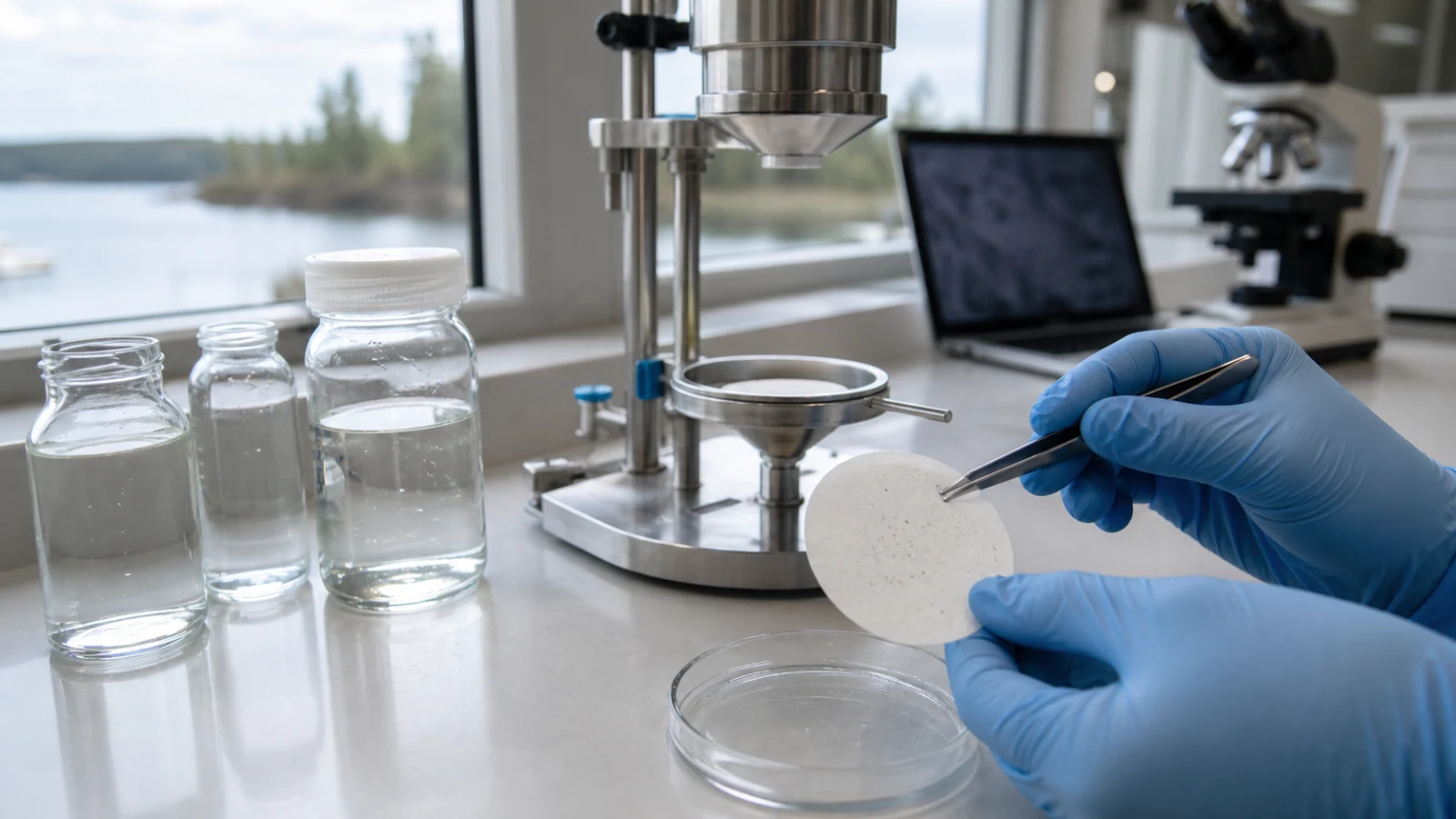
Answer First: The Useful Takeaway
The practical lesson is simple: microplastic numbers are only useful when you know what size range, polymer types and method limits sit behind them. The new study is useful because it targets smaller particles than many routine reports and links particle sizing with polymer identification. The authors describe an approach that identifies six environmentally relevant polymers in the 5-100 µm range and can project results across 1-100 µm. In their samples, the smaller fraction changed the interpretation of pollution levels.
For readers, educators and businesses, the strongest response is not panic. It is better questioning. When a product, campaign or local report claims progress on microplastics, ask: what particles were measured, how small could the method see, which polymers were identified, how was contamination controlled, and can the result be compared with another site or year?
What The New Study Adds
The paper, by Christel S. Hassler, Rafael Peixoto, Florian Breider, Merve Tunali and Filippo De Franceschi, was published in npj Clean Water, volume 9, article 62. Its central contribution is methodological. The authors combine spectral flow cytometry with machine learning so that particles can be counted and classified by polymer type at high throughput. That matters because older or simpler monitoring often reports particle counts without enough chemical identity, or focuses on larger particles because they are easier to isolate and analyse.
Why 1-20 µm Is A Different Monitoring Problem
A particle below 20 µm is not just a smaller version of a visible fragment. It is harder to sample without contamination, harder to separate from natural particles, harder to identify confidently, and harder to compare across labs. The Nature paper notes that many environmental reports use thresholds above 100 µm, while toxicity studies often work below 100 µm. That gap weakens risk assessment because exposure data and effect data are not always describing the same particle sizes.
The authors report clear differences between Lake Geneva, nearby rivers, and surface versus deep water samples. They also report that up to 97 percent of detected microplastics were between 1 and 20 µm in the sampled contexts, and that small-particle concentrations in lake waters could exceed previous reports by up to 656-fold. Those are not global averages. They are a warning that measurement design can strongly influence the apparent scale of pollution.
Why Polymer Identity Matters
Counting particles without knowing what they are can mislead policy and operations. A fibre from clothing, a tyre-wear particle, a fragment of packaging and a natural particle can behave differently. The Nature paper targeted six major polymers relevant to environmental and human-health discussions. A separate 2025 peer-reviewed study on flow Raman spectroscopy reached a similar direction of travel: better small-particle methods should reduce the effort needed to detect and identify microplastics, and Raman-based systems can distinguish plastic types in very small particles.
For a school project or community group, this means a clean-up count is useful but not the same as microplastic monitoring. For a water utility, it means method choice can affect investment decisions. For a hospitality or retail operator, it means prevention still matters even if the particles are too small to see.
How This Fits EU And Global Monitoring
The European Commission's Joint Research Centre has been moving in the same direction: harmonised sampling, analysis and reporting. In April 2024 the JRC announced a methodology to measure microplastics in EU drinking water. It highlighted why measurement is difficult: microplastics vary in size, shape, composition and chemical identity. The JRC approach uses large-volume sampling, filters at 100 µm and 20 µm, and analysis by infrared microscopy or Raman microscopy. Its aim is comparability, not dramatic headlines.
A later JRC publication explains the policy context. When the recast Drinking Water Directive entered into force in January 2021, no suitable standardised or harmonised methodology was available for microplastics in drinking water. The Commission then adopted Delegated Decision (EU) 2024/1441 on 11 March 2024, drawing on the JRC technical work. That does not solve every monitoring problem in rivers, lakes or wastewater, but it shows that method design is now part of mainstream water policy.
UNEP's freshwater monitoring guidance also makes the same broader point: monitoring programmes are needed to assess the state of plastic pollution and track trends. Freshwater matters because rivers and lakes are not merely scenic victims. They can be pathways, sinks and sampling points for land-based plastic pollution. If methods are inconsistent, the evidence base for prevention, regulation and local action remains weaker than it should be.
What This Means For Readers And Organisations
For consumers, the new research is not a reason to buy every product marketed as anti-microplastic. Many such claims are narrow, unverified or irrelevant to the main sources of release. Better actions remain boring but useful: reduce avoidable single-use packaging, choose durable products, wash and maintain synthetic textiles more carefully, avoid unnecessary intentionally added microplastics, and support systems that prevent leakage before it fragments.
For educators, the article is a chance to teach evidence literacy. Students can compare a litter survey, a macroplastic river count and a microplastic lab report, then ask why the numbers cannot be merged casually. A classroom can still use simple sampling demonstrations, but should explain that professional microplastic claims require contamination controls, polymer identification and stated detection limits.
For small businesses and hospitality operators, the most useful response is to prevent plastic release upstream. That includes procurement choices, refill systems, laundry practices, pellet and powder handling where relevant, and avoiding vague green claims. If your business is already exploring reuse or refill, connect microplastic prevention with wider packaging policy rather than treating it as a separate marketing topic. The current Beat Plastic Pollution guide to reusable packaging systems under the EU PPWR is a helpful related starting point, and the article on responsible bathroom packaging and refill choices shows how this thinking can reach everyday amenities.
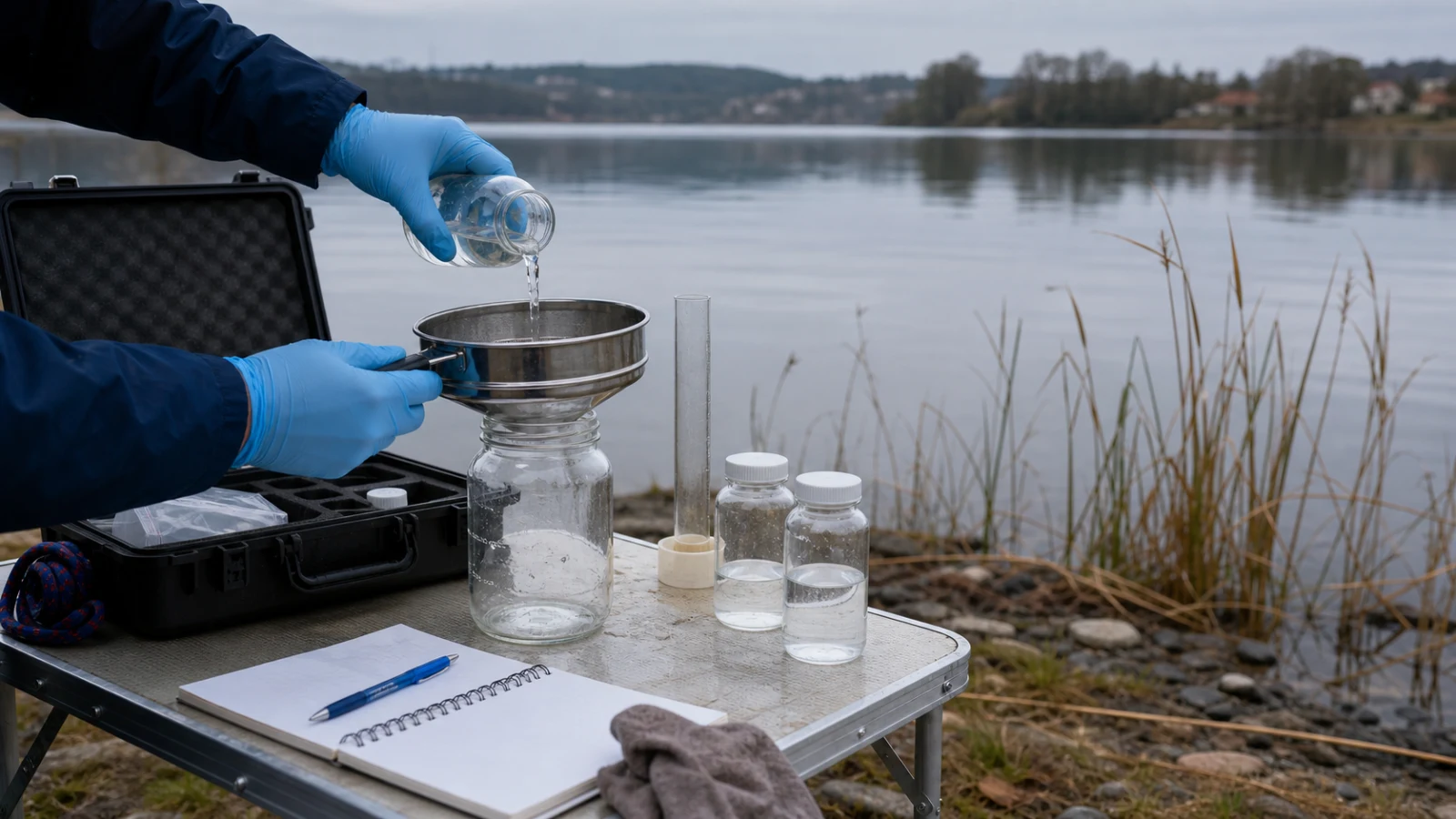
A Practical Checklist Before You Trust A Microplastics Claim
- Check the size range. A result for particles above 100 µm cannot be compared directly with a result down to 20 µm or 1 µm.
- Ask for polymer identification. Strong reports identify whether particles are polyethylene, polypropylene, PET, polystyrene or another material.
- Look for contamination controls. Airborne fibres, lab plastics and handling can contaminate samples if controls are weak.
- Separate drinking water, surface water and wastewater. Each matrix has different sampling and interpretation limits.
- Beware of single-number certainty. A count without method details is not enough for policy, procurement or health claims.
- Prefer prevention over end-of-pipe promises. Filters and clean-ups have a role, but avoiding release is usually more robust.
- Connect monitoring to action. Useful data should tell someone what to change, whether that is product design, handling, laundering, packaging or local waste prevention.
Where Policy Is Already Moving
EU policy is no longer limited to beach litter or visible packaging waste. The Commission's microplastics page points to the 2023 REACH restriction on intentionally added microplastics and to the 2025 plastic pellet loss regulation. The pellet rule applies to economic operators handling five tonnes or more of plastic pellets per year in the EU, including manufacturers, recyclers, converters, stockists and carriers. Larger handlers have stronger compliance duties, while all covered operators must prevent, contain and clean up losses.
That policy direction matters because small particles often begin as preventable releases: pellets, fibres, fragments, powders, tyre wear or packaging residues. Monitoring can reveal the problem, but rules and operating habits determine whether the next sample is better. For hospitality venues, wellness businesses and other service operators, that can mean refill amenities, careful waste handling and procurement that favours lower-shedding, longer-life materials. The related Beat Plastic Pollution article on responsible wellness operations is relevant for readers thinking about guest-facing environments.
Conclusion: Better Measurement Should Lead To Better Prevention
The new Nature study should not be read as a final answer on microplastics in every water body. It should be read as a strong reminder that what we do not measure well can be underestimated. Smaller particles are technically difficult, policy-relevant and likely to change how some monitoring results are interpreted.
The useful response is disciplined curiosity. Ask better questions about size ranges, polymer identity and detection limits. Support harmonised public monitoring. Be cautious with product claims. Reduce avoidable releases where you control purchasing, operations or design. Microplastic pollution is complex, but the next practical step is clear: improve the evidence and use it to prevent particles from entering water in the first place.
FAQ
Does this study prove my local water is unsafe?
No. The study reports findings from specific natural water samples and a specific analytical method. It improves the monitoring conversation, but it does not provide a direct safety conclusion for every drinking water or local lake.
Why are smaller microplastics harder to measure?
They are harder to separate from natural particles, easier to contaminate during sampling, and require methods that can identify polymer type at very small sizes. Method limits must be reported clearly.
Can household filters solve the issue?
Some filters may reduce certain particles, but performance depends on particle size, filter type and maintenance. Prevention at source, better monitoring and lower plastic leakage remain more reliable system-level actions.
What should businesses do first?
Start with avoidable releases: single-use packaging, poor pellet or powder handling, high-shedding textiles, weak waste controls and vague refill systems. Measure claims carefully before using them in marketing.
Sources
- Revisiting microplastic pollution: A novel method for detecting small-sized microplastics in natural waters, npj Clean Water, 2026.
- New methodology to measure microplastics in EU's drinking water, European Commission Joint Research Centre, 2024.
- Analysing microplastics in drinking water, JRC Publications Repository, 2025.
- Microplastics, European Commission environment policy page.
- Flow Raman Spectroscopy for the Detection and Identification of Small Microplastics, Sensors, 2025.