Reusable Packaging Systems: What Europe’s New Rules Really Mean
Reusable packaging is moving from an appealing sustainability idea toward a regulated operating model. In the European Union, the Packaging and Packaging Waste Regulation, usually shortened to PPWR, begins to apply generally on 12 August 2026. That date matters because the regulation does more than encourage better recycling. It creates common requirements for packaging prevention, reuse, refill, recyclability, consumer information and producer responsibility.
For readers, the practical question is not whether a bottle, cup, box or tub carries a reusable label. It is whether the entire system keeps that package in circulation often enough to replace single-use items without creating avoidable impacts through extra transport, washing, losses or overbuilt materials. A durable container alone is not a reuse system.
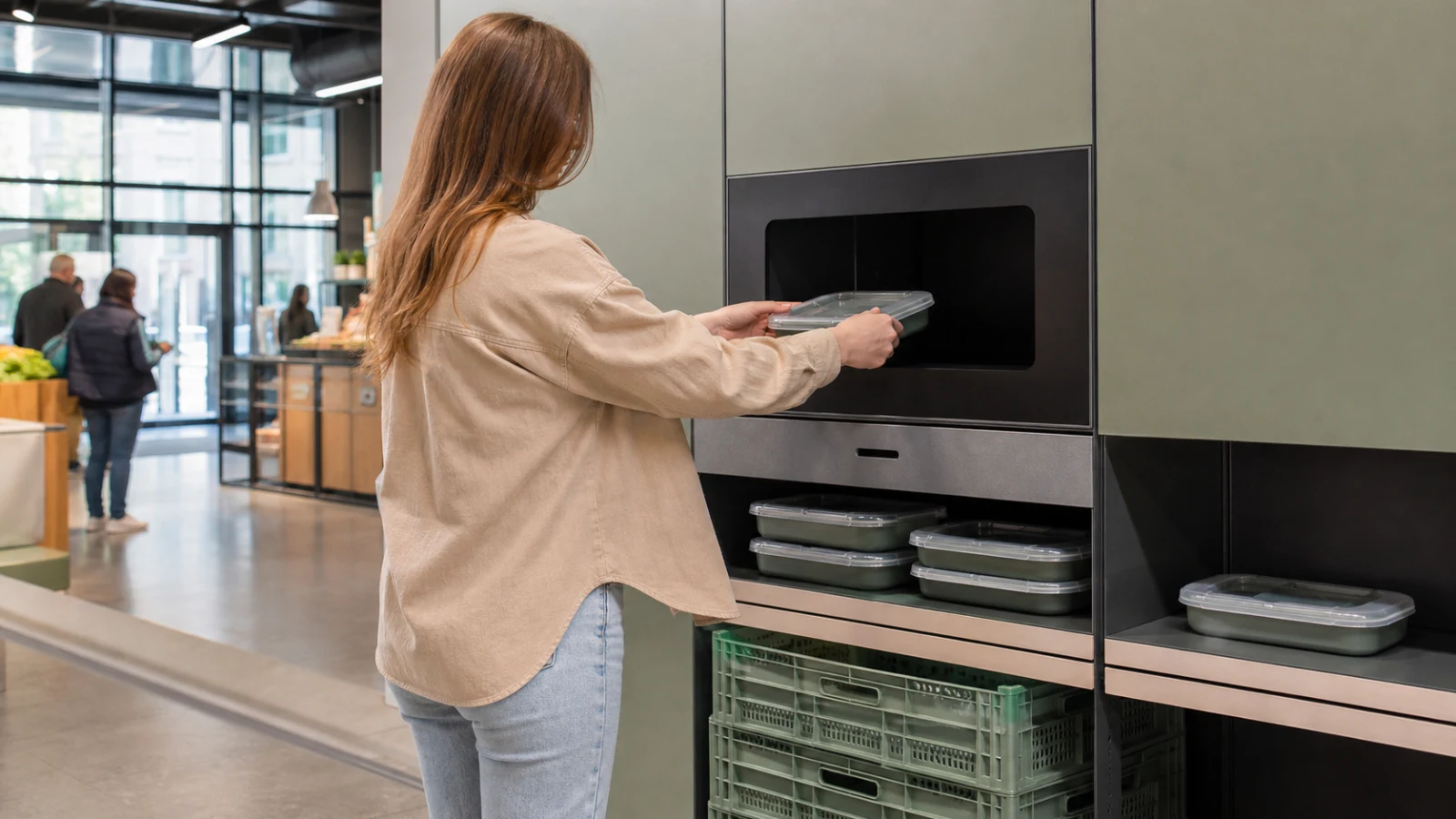
The short answer: reuse is now about systems, not slogans
The PPWR treats reusable packaging as packaging deliberately designed for multiple uses or rotations. It must withstand normal handling, remain safe and hygienic, be refillable or reloadable without losing its function, and be capable of reconditioning. It must also be recyclable when it eventually reaches the end of its useful life. The official text of Regulation (EU) 2025/40 places these conditions in Article 11.
This definition is important because it separates genuine reuse from an informal suggestion to use an ordinary disposable package again. A thin takeaway tub that a household happens to keep is not automatically part of a verified reuse model. A system needs compatible packaging, collection or refill points, cleaning or reconditioning rules, traceability where necessary, and a realistic path back to the next use.
The regulation also recognises refill, where a consumer’s own container or a durable container supplied by an operator is filled again. Return and refill are related but not identical. In a return model, the operator usually owns or manages a pool of standard packages. In a refill model, the consumer may retain the same container. Both approaches succeed only when they displace new packaging rather than adding another layer to the transaction.
Why August 2026 is a turning point
The European Commission’s packaging waste overview confirms that the PPWR entered into force on 11 February 2025 and generally applies from 12 August 2026. Its scope covers packaging of every material and origin, not plastic alone. It addresses how packaging is designed, placed on the market, used and managed as waste.
The policy direction is a hierarchy. Avoid unnecessary packaging first, make reuse or refill workable where appropriate, and ensure the remaining packaging can be recycled effectively. That order corrects a common misunderstanding: collecting more disposable packaging for recycling is not the same as preventing packaging waste.
The regulation introduces different obligations on different timelines. It does not require every shop to replace every package with a reusable version in August 2026. Some reuse targets and format restrictions apply later, and exemptions exist for certain operators, products and circumstances. Businesses therefore need to check the exact provision that applies to their activity instead of relying on a simplified social-media summary.
What the new framework changes for everyday packaging
Clearer requirements for a package to count as reusable
Packaging must be conceived for repeated use and designed to complete as many rotations as possible under predictable conditions. It must be capable of being emptied, cleaned, refilled or reloaded while preserving product quality and safety. Operators also need technical information that supports conformity. These requirements discourage purely decorative reuse claims on packages that lack a functioning return or refill pathway.
Targets for selected commercial formats
The official EUR-Lex PPWR summary explains several 2030 targets. They include 40% reusable transport packaging, 10% reusable grouped packaging and a 10% target for beverages distributed in reusable packaging, subject to the regulation’s detailed conditions and exemptions. The targets are not interchangeable: transport crates, grouped packaging and consumer beverage containers operate through different loops.
Restaurants and cafés will also face practical consumer-facing steps. By 2027, takeaway customers must be able to use their own suitable containers without an additional charge. By 2028, takeaway operators must offer a reusable packaging option without charging more than for the same product in single-use packaging. Hygiene and food-safety requirements continue to apply.
Less tolerance for avoidable packaging
Reuse sits alongside rules designed to reduce empty space and unnecessary material. From 2030, grouped, transport and e-commerce packaging filled by operators is generally subject to a maximum empty-space ratio of 50%. Certain single-use formats will also be restricted. This matters because the strongest reuse programme cannot compensate for a business that continues to add unnecessary wraps, sachets or secondary boxes elsewhere.
Reusable does not automatically mean lower impact
A reusable package normally requires more material and energy to manufacture than a lightweight disposable equivalent. Its environmental advantage appears only after enough successful uses spread that initial impact across many transactions. Return rates, breakage, loss, washing, transport distance, energy sources and the single-use package being replaced all affect the result.
A 2026 Associated Press report on refill stores highlights this payback principle and notes that special journeys made only to refill can reduce or cancel expected benefits. The lesson is not that refill is ineffective. It is that convenience and logistics are environmental variables, not merely customer-service details.
Material choice also needs context. Glass is durable and easy to clean but heavy to transport. Plastic can be lighter but may scratch, stain or reach its safe-use limit sooner in some applications. Stainless steel can survive many cycles but has a higher manufacturing footprint. No material wins in every system. The correct comparison is between complete delivery models providing the same function.

Five tests for a credible reuse or refill programme
1. It replaces a clearly defined single-use package
A programme should state what it displaces: a takeaway cup, delivery box, hotel amenity bottle or transport wrap. If reusable packaging is handed out alongside the same volume of disposables, the operator may be increasing material use rather than preventing waste. A baseline makes the claim measurable.
2. Returning or refilling fits an existing routine
Collection points should be close to where customers already shop, work, travel or return products. Deposits must be large enough to encourage returns without excluding customers. Instructions should be short and consistent. A system that depends on a special car journey or a rarely open counter will struggle to achieve the rotations used in its environmental model.
3. The operator measures rotations, returns and losses
Purchasing 10,000 durable cups proves only that 10,000 cups were purchased. A useful dashboard records how many times packages are issued, returned, rejected, lost and retired. It should distinguish packages recirculated from packages merely collected. Businesses already working on measuring waste and operating costs can add these indicators to purchasing and inventory records.
4. Cleaning and reverse logistics are designed efficiently
Washing must protect health and product quality while controlling water, energy and detergent use. Standard package shapes can improve crate density and simplify cleaning. Shared collection and washing infrastructure may reduce journeys when several nearby businesses use compatible containers. Poorly coordinated transport can erase benefits that look convincing when only the package itself is assessed.
5. Claims show assumptions as well as results
A trustworthy claim identifies the comparison, geography, return rate, number of rotations and relevant life-cycle boundary. “Reusable” describes a design capability. “Reused 24 times on average in this city-wide system” describes performance. Readers should be cautious when a company publishes a distant future target but no current return or loss data.
What consumers can check before participating
- Return route: Is there a convenient point, collection service or refill location you will genuinely use?
- Deposit: Is the amount and refund process clear before purchase?
- Hygiene: Does the operator explain who cleans the package and what condition is acceptable for return?
- Outcome: Is the package refilled, reused, recycled or simply collected without a stated destination?
- Evidence: Does the operator report actual rotations or only the number of reusable items distributed?
- Fit: Can you combine the return with an ordinary trip rather than create a new journey?
Consumers do not need to calculate a complete life-cycle assessment at the counter. They can still distinguish a usable loop from a vague promise. Clear instructions, nearby returns, refundable deposits and transparent results are positive signals.
A practical checklist for small businesses
Start with one high-volume package and map its current flow from purchase to disposal. Count units, material, weight, cost and contamination problems. Then design the proposed loop: package ownership, deposit, collection, washing, inspection, storage, redistribution and end-of-life recycling.
Pilot the system in a compact area where returns can be integrated into existing deliveries. Set a minimum performance threshold before expanding. Useful indicators include return rate, average rotations, loss rate, rejected packages, kilometres per return, wash energy and water per unit, and single-use packages avoided. Report both successes and weak points.
Hospitality operators can connect the same method to broader responsible hospitality decisions. Bathroom and personal-care suppliers can begin with the packaging questions in our guide to bathroom refill packaging. The goal is not to force one container format into every service. It is to remove single-use items where a safe, convenient and measurable loop can replace them.
How reuse fits the wider plastic-pollution strategy
Reuse is one part of a larger system change. The United Nations Environment Programme’s Turning off the Tap roadmap estimates that reuse options such as refillable bottles, bulk dispensers, deposit-return schemes and take-back programmes could reduce plastic pollution by 30% by 2040. UNEP presents reuse alongside eliminating problematic uses, improving recycling and carefully reorienting products and materials.
That estimate is a global scenario, not a guarantee for every cup or bottle. Its value is to show the potential scale of well-designed systems. Local programmes still need operational evidence. Prevention remains the first question: can the package be avoided? Reuse follows when the function still requires packaging and repeated circulation is practical. Recycling remains necessary when a reusable package finally wears out.
Conclusion: judge the loop, not the label
Europe’s PPWR gives reusable packaging a clearer legal and operational meaning. It also creates timelines that will make return, refill and packaging prevention more visible in shops, cafés, transport systems and supply chains. The opportunity is substantial, but durable packaging becomes environmentally useful only when it returns, remains safe and completes enough rotations.
The best question is therefore not “Is this container reusable?” Ask: “How does it come back, how often is it actually reused, what does it replace, and how are the results measured?” A credible operator should be able to answer all four.
Frequently asked questions
When does the EU Packaging and Packaging Waste Regulation apply?
Regulation (EU) 2025/40 entered into force on 11 February 2025 and generally applies from 12 August 2026. Individual obligations and targets have their own later dates, so businesses should check the relevant article and any applicable exemption.
Does reusable packaging always have a lower environmental impact?
No. It needs enough successful rotations to offset its production, washing and return impacts. Material weight, transport, energy, water, breakage and loss rates all influence the comparison with single-use packaging.
What is the difference between return and refill?
In a return system, packaging normally goes back to an operator for inspection, cleaning and redistribution. In a refill system, the consumer may keep the same container and fill it again. Both models need safety rules and a practical way to avoid new single-use packaging.
What should a business measure in a reuse pilot?
Measure the return rate, completed rotations, losses, rejected containers, cleaning inputs, transport distance, total cost and the number of single-use packages genuinely avoided. Publishing these assumptions makes environmental claims easier to assess.
Sources and further reading
- Regulation (EU) 2025/40 on packaging and packaging waste, EUR-Lex.
- Packaging and packaging waste from 2026: official summary, EUR-Lex.
- Packaging waste overview, European Commission.
- UN roadmap outlines solutions to cut global plastic pollution, United Nations Environment Programme.
- How refill stores are changing the way we reduce waste, Associated Press.