Marine Microplastic Monitoring: How Better Data Helps Ocean Action
Marine microplastics are hard to manage for a simple reason: they are hard to measure well. A bottle, bag or fishing crate can be counted on a beach. A fragment smaller than a grain of rice may pass through a net, drift below the surface, mix with natural particles, or show up in one laboratory but not another because the sampling and analysis were different.
That measurement problem is now becoming a policy problem. Governments, researchers and businesses are being asked to act on plastic pollution while the evidence base is still uneven. A new wave of marine microplastic monitoring work, including the IAEA's NUTEC Plastics platform, better laboratory methods from marine institutes and recent ocean-wide synthesis work, points toward a practical answer: make the data more comparable before asking it to carry bigger decisions.
The Short Answer: Better Monitoring Turns Tiny Particles Into Usable Evidence
Better marine microplastic monitoring does not make pollution disappear. It does something more basic and badly needed: it helps scientists, regulators and communities compare results across places, depths and time. When sampling protocols, particle-size limits, polymer identification and reporting formats are harmonised, a coastline survey in one country can be compared with a river-mouth survey elsewhere without pretending the two are identical.
The practical result is sharper decision-making. A city can tell whether wastewater upgrades, storm-drain filters or single-use plastic restrictions are changing local conditions. A hospitality group can separate credible refill and procurement actions from vague green claims. A school or citizen-science project can understand where its observations are useful and where specialist lab work is needed.
Why Marine Microplastic Data Is So Difficult To Compare
Microplastics are usually defined as plastic particles between 1 micrometre and 5 millimetres. That range is enormous in monitoring terms. It includes fibres, fragments, films, foams and beads; particles that float, sink or ride on organic matter; and materials that have been weathered by sunlight, abrasion, biofouling and pressure.
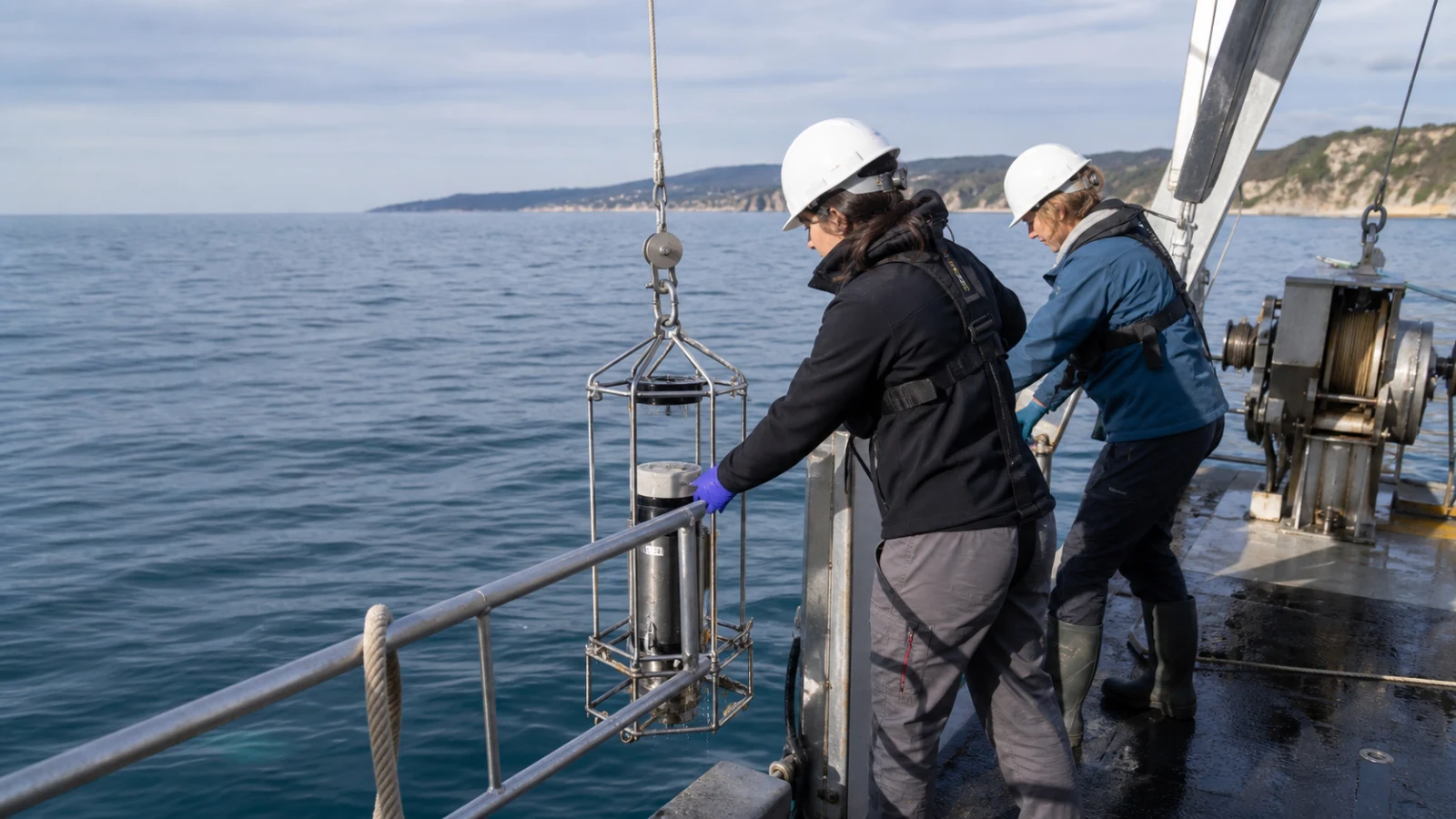
The easiest samples are near the surface, so much of the historical evidence has focused there. Eos, summarising recent ocean-column research, notes that a focus on the upper 50 centimetres leaves much of the water column poorly understood. That matters because the ocean is not a flat surface. Particles move vertically, interact with plankton and marine snow, and may reach organisms far below the places where public clean-ups happen.
Comparability is the other challenge. Different studies may use different nets, mesh sizes, digestion steps, staining methods, imaging tools and polymer-identification thresholds. Some count fibres. Others exclude fibres because contamination is difficult to control. Some report particles per cubic metre of water; others report particles per square metre per day as sinking flux. Eos describes measured water-column concentrations varying by up to eight orders of magnitude across studies, a signal that method differences can overwhelm the reader's ability to interpret trends.
What Changed In July 2026
The timely hook is the IAEA's July 2026 launch of the NUTEC Plastics Global Marine Monitoring Platform. The platform is designed as an online repository for data from a network of marine monitoring laboratories supported by the IAEA's NUTEC Plastics initiative. Its core value is not that one database is glamorous. It is that countries need shared protocols and a common place for results if they want to track marine microplastic concentrations and trends over time.
The IAEA-linked release reports that scientists have worked on harmonised protocols for sampling, separating and identifying microplastics in beach sand and surface waters. It also says more than 400 technical specialists have been trained and more than 80 countries have received sampling or analytical equipment to strengthen local capacity. Those numbers are not a substitute for prevention, but they show that monitoring is becoming a capacity-building issue, not only a laboratory niche.
One detail deserves attention from non-specialists: the platform depends on equipment and protocols that help local laboratories process samples without contamination and identify plastics by material. The cited equipment includes ATR-FTIR spectroscopy, a method used to identify the chemical composition of particles. In plain English, this helps distinguish plastic fragments from sand, shell, organic matter or laboratory contamination.
The Lab Methods Are Improving Too
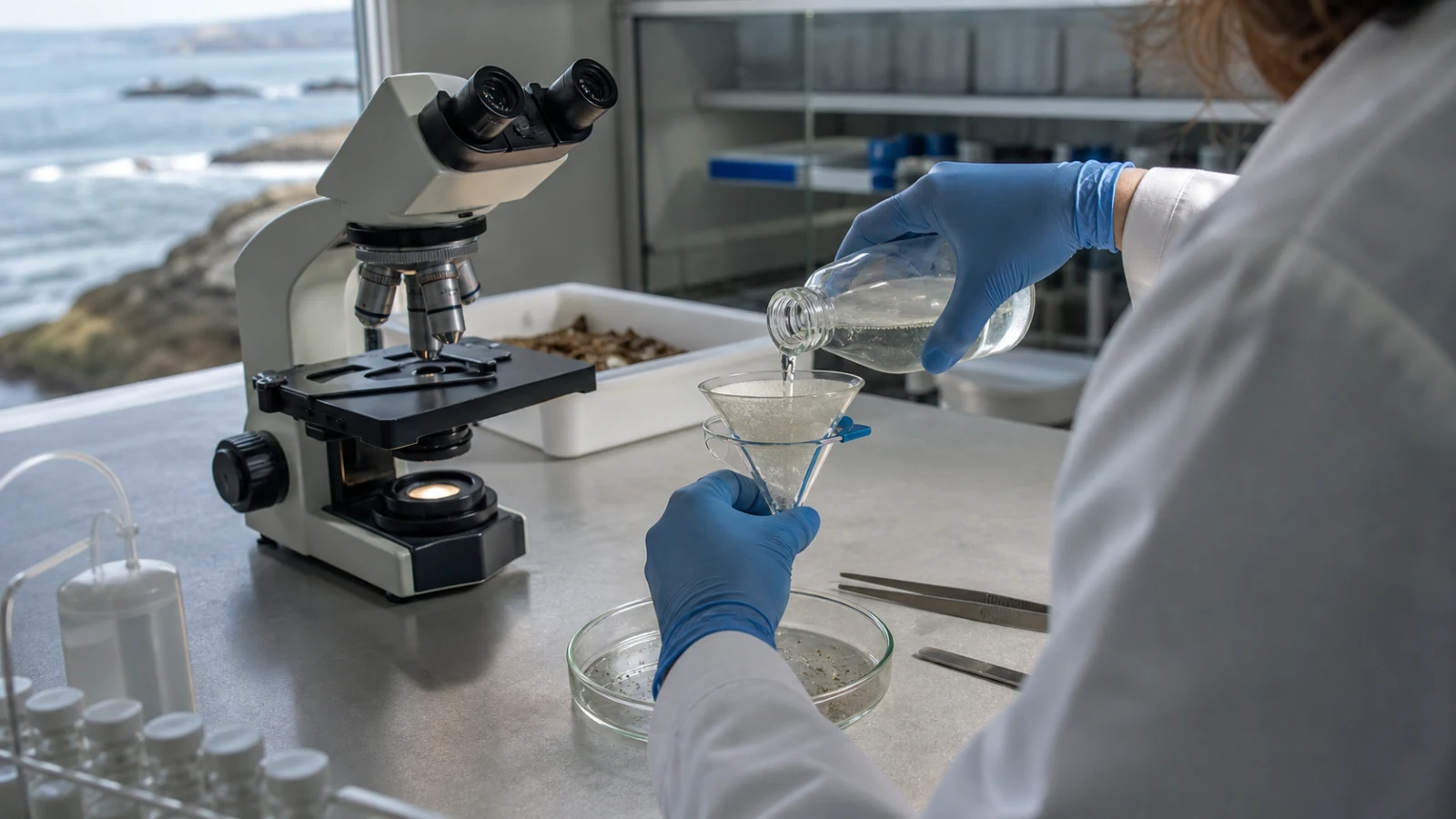
Monitoring also improves when the analysis gets faster and more affordable. The Flanders Marine Institute reported that Nelle Meyers, working with VLIZ, ILVO and Ghent University, developed a semi-automatic method for detecting and identifying marine microplastics. The method combines Nile Red staining, fluorescence microscopy and machine-learning algorithms. VLIZ says it tested reliably for most polymer types, including artificially weathered particles, and was successful on real marine samples.
That kind of method matters because the monitoring bottleneck is often not collecting a bottle of seawater. It is processing enough samples with enough quality control to say something meaningful. If analysis remains too expensive, too slow or too dependent on a small number of specialised experts, monitoring will stay patchy. If methods become more repeatable and transparent, more regions can build credible baselines.
What Nile Red And Imaging Can Do
Nile Red is a fluorescent dye that can help highlight plastic-like particles under controlled conditions. It is not magic and still needs validation, because natural organic material and weathered plastics can complicate interpretation. Combined with microscopy and machine learning, however, it can support faster screening and make small-particle analysis more practical.
What Spectroscopy Adds
Spectroscopy tools such as FTIR add material identification. That matters when the policy question is not just, "How many specks are present?" but, "What are they made of, where might they come from and which interventions could reduce them?" A fibre-heavy sample may point toward textiles or wastewater. A fragment-heavy sample near a tourism beach may lead to different prevention steps.
What This Means For Policy, Business And Communities
Better monitoring should make plastic action less performative. A municipality considering capture devices, deposit-return systems, wastewater upgrades or restrictions on specific single-use items needs baseline data and repeat measurements. Without them, it is easy to confuse activity with impact.
For businesses, especially hospitality and food-service operators, the implication is more grounded. Monitoring will not prove that one hotel bathroom caused a microplastic result offshore. But it strengthens the evidence behind upstream choices: reduce unnecessary single-use packaging, specify refillable systems where hygiene and operations allow, and document procurement changes. Readers planning packaging changes can pair this monitoring perspective with our guide to reusable packaging systems under the EU PPWR.
For consumers and educators, the lesson is to be precise. Beach clean-ups still matter, but they are not a complete microplastic strategy. Laundry habits, tyre wear, cosmetic ingredients, disposable packaging, paint, fishing gear and wastewater systems all influence particle flows. If your focus is bathrooms and amenities, our responsible shower gel and refill bathroom guide is a useful companion because it moves from awareness to purchase and refill decisions.
What Good Monitoring Should Ask Before The Next Headline
Not every microplastics headline deserves the same confidence. Before sharing a striking claim, ask whether the study describes sample size, location, depth, season, particle-size limits, contamination controls and polymer identification. A result from beach sand is not the same as a result from deep water. A screening method is not the same as confirmed polymer analysis. A pilot study can be valuable without being universal.
Good monitoring also separates exposure from harm. Finding particles in a place or organism is important, but risk depends on concentration, particle size, polymer, additives, weathering, exposure pathway and biological response. The best public communication explains what is known, what remains uncertain and what action is still justified by prevention principles.
A Practical Checklist For Readers
- Prefer claims that name the sampling location, date range, depth and particle-size range.
- Look for clear contamination controls, especially when fibres are reported.
- Check whether the study identifies polymer type or only counts suspected particles.
- Treat single-site studies as local evidence, not a global average.
- Support upstream prevention: less unnecessary packaging, better reuse systems and refill options.
- For schools and community groups, use citizen science to map visible litter and pair it with expert lab partners for microplastic claims.
- For businesses, document procurement changes so future monitoring can be interpreted alongside real operational shifts.
Conclusion: Measurement Is Not The Mission, But It Makes Action Smarter
Marine microplastic monitoring is entering a more useful phase. The goal is not to turn plastic pollution into a dashboard and call the problem solved. The goal is to give prevention work a clearer compass. Shared protocols, trained laboratories, better imaging, spectroscopy and common platforms can show whether policies and business changes are moving conditions in the right direction.
The strongest lesson for readers is practical: do not wait for perfect data before reducing avoidable plastic use, but do demand better data before accepting sweeping claims. The ocean needs less plastic entering it. Better monitoring helps reveal where the reductions are real.
Frequently Asked Questions
What is marine microplastic monitoring?
It is the organised sampling and analysis of tiny plastic particles in seawater, beach sand, sediments or marine organisms. Good monitoring records where samples came from, how they were processed and how particles were identified.
Why are microplastic results hard to compare?
Studies may use different mesh sizes, depths, laboratory methods and reporting units. Unless those methods are transparent or harmonised, two numbers can describe different things even if both look precise.
Does better monitoring reduce plastic pollution by itself?
No. Monitoring is evidence infrastructure. It helps people choose, target and evaluate prevention measures, but the actual reductions come from policy, product design, reuse systems, procurement and everyday behaviour.
Can community groups monitor microplastics?
Community groups can help with litter surveys, sample collection and local awareness, but claims about microscopic particles usually need trained laboratories, contamination controls and validated identification methods.